
By A Manly Guest Contributor
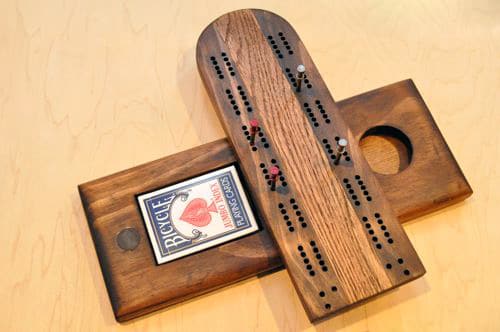
Editor's note: This is a guest post by Ethan Hagan from One Project Closer. I love a good card game, and some of my favorites include Spades, Hearts, Hand and Foot, and Euchre. Poker, however, never quite goes my way. Believe it or not, I’ve never played cribbage before. However, when Brett challenged me to make a cribbage board, I thought it would be a lot of fun. I started reading up on Cribbage rules and found a lot of custom-made boards on the web. I decided on a “classic style” board that follows a design I found on other woodworking sites, and it’s perfect for a moderately skilled woodworker like myself. The board has enough holes to play a 61 point game, as opposed to a 121 point game. Tools and Materials To make my crib board I used some scrap 3/4″ pine, 1/4″ plywood, and I purchased some oak from the local DIY center. I printed out a hole template, which I modified to meet my needs. The pegs are made from double-headed nails, which you’ll typically see used to make concrete forms. The two magnets and wood stain are leftovers from other projects. 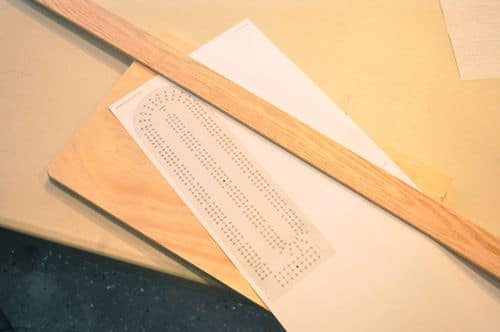
Pine is a soft wood so it wouldn’t have been too difficult to cut by hand, and by omitting a few steps, the only necessary power tool is a drill press. I have the tools (so I took advantage of them), and here’s what I used. - Table saw
- Dado stack
- Coping saw
- Palm router
- Table router
- Drill press
- Sandpaper
- Angle grinder
- Bench grinder
Make a Custom Cribbage Board 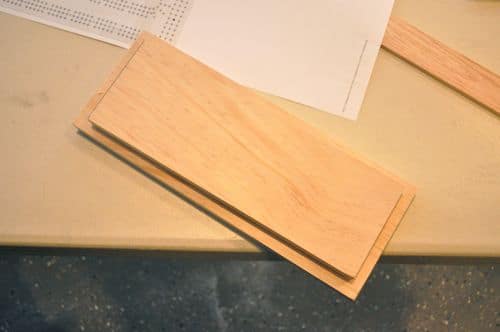 I started by running my pine through a table saw to create two pieces. The top measured 4 x 12″ and the base measured 5-1/8 x 13-1/4″. I also ripped the 1/4″ ply to match the base. 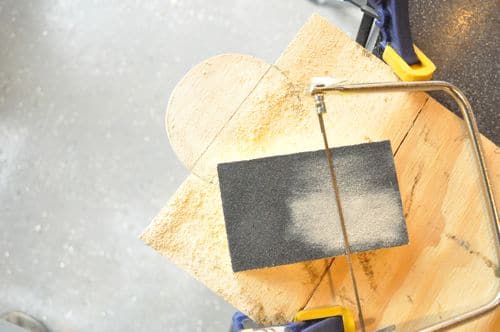 I wanted to cut a semi-circle on one side of the top, and I started by creating a template. The template is useful because I can tweak it as necessary until I’m completely satisfied, then use it to easily cut a perfect match on my workpiece. 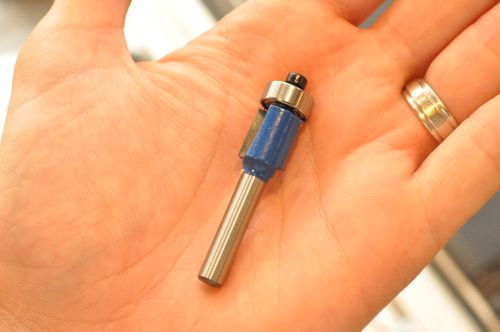 This router bit has a bearing on the end for following templates. 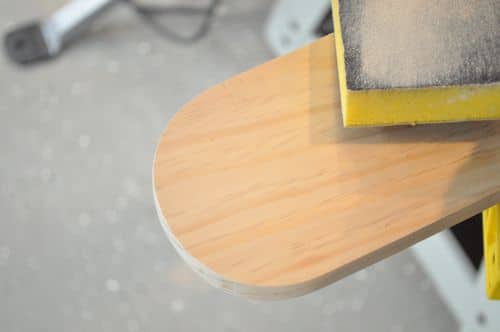 After making a rough cut, I used a palm router and my template to cut a beautiful semi-circle. 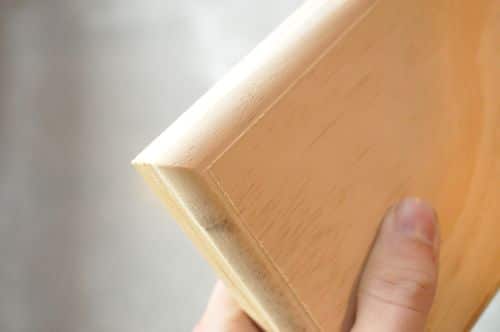 For the base, I used another router bit to cut an eased-edge. 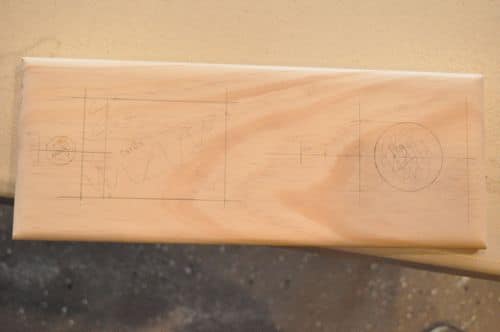 Next, I mapped out the locations for the playing card holder, peg holder, magnet, and swivel pin. 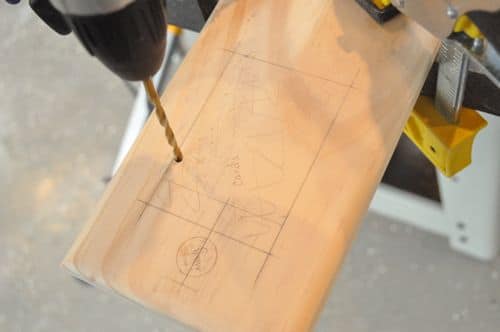 I drilled a starting hole and cut out the playing card and peg holders with my coping saw. 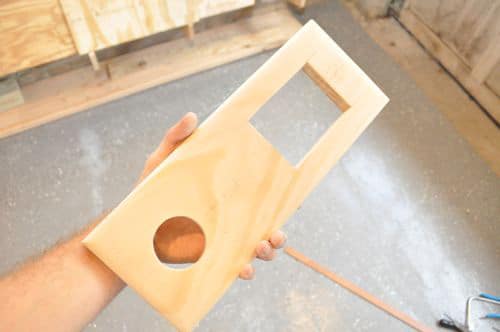
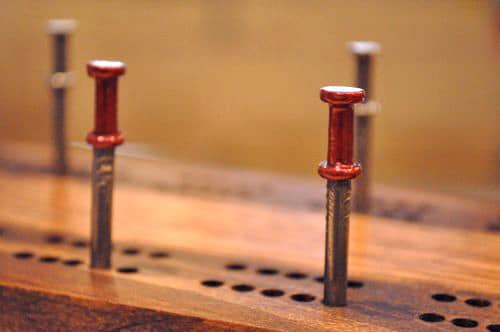
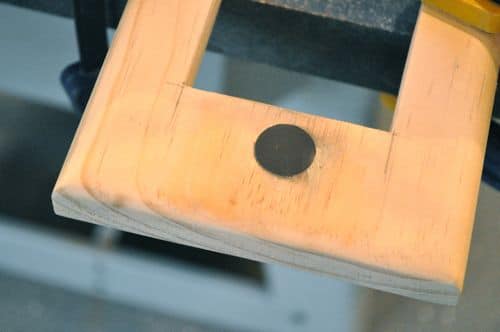 For the magnets, I used my palm router again, setting the depth to match their height. Carefully, I routed the magnet holes on the base and underside of the top. 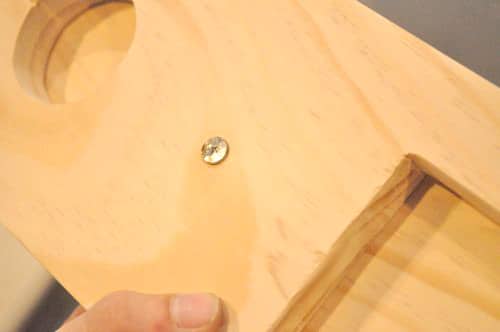 The top and base swivel on a pin to reveal the playing cards and cribbage pegs. Instead of a pin, I cut a machine screw to length and then ground the head as thin as possible. I drilled a hole through the base and part-way through the top. 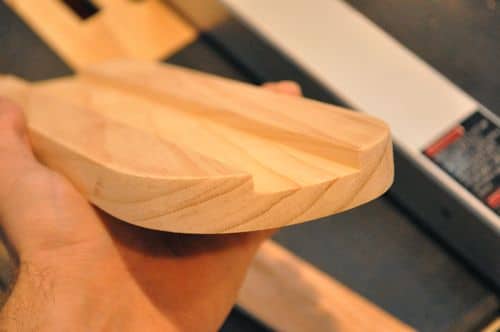 A nice feature you’ll see on a lot of cribbage boards is a “racing stripe” down the middle. I set up a dado stack on my table saw to cut a channel for the oak inlay. 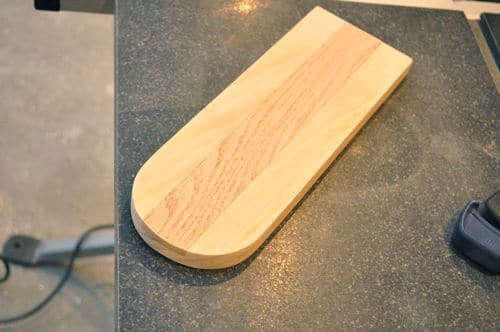 I made a rough cut for the curve and sanded both ends until the oak was completely flush with the pine top. 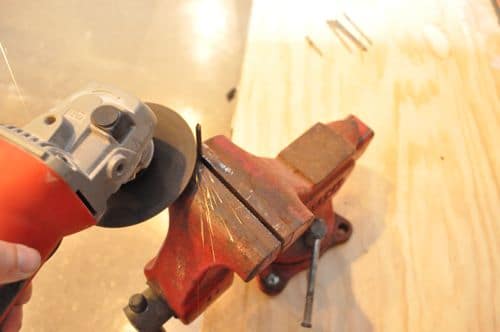 As I mentioned, I used double-headed nails to make the cribbage pegs (spilikins). I cut the nails to length with my angle grinder, and then dressed up the cut edge with a bench-top grinder. 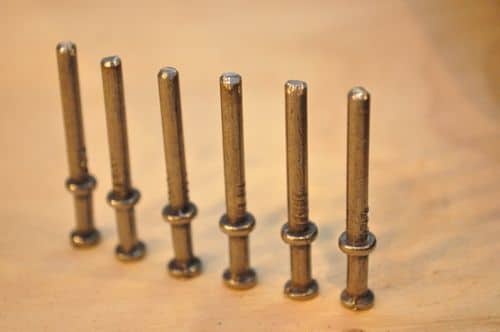
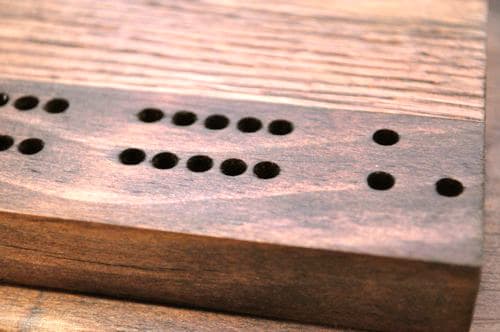
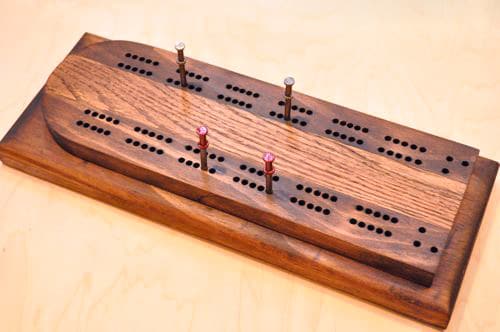
I borrowed a drill press and used a 11/64″ bit to drill all the holes. After taping my template in place, aligning the fence, and setting the depth, things moved pretty quickly. Next, I glued the oak to the top and the 1/4″ plywood to the underside of the base. I gave everything a final pass with sandpaper to remove any pencil marks or glue. Next, I applied a walnut stain to the entire cribbage board, letting the two different species of wood create some visual interest. To distinguish the pegs, I painted one pair a dark red. What do you think? 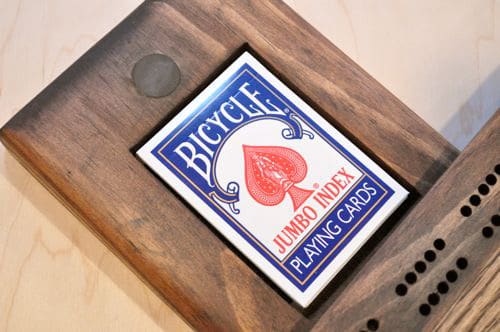
__________________________________________________________ Ethan Hagan owns and operates a home improvement website called One Project Closer. On One Project Closer you’ll learn how to tackle projects with expert knowledge from professional contractors. OPC also provides coupons to home improvement centers like this Home Depot Coupon page. Check out OPC for full details, and follow them on Facebook. No related posts. 


By Brett & Kate McKay
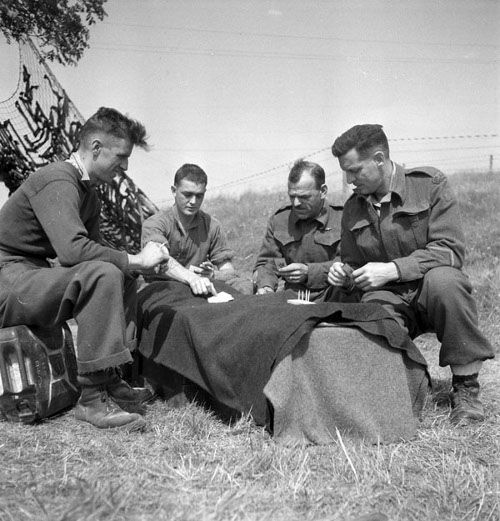
"While I was sitting there thinking of how Bill was a major artist and how even the knots he tied were artistic, he had somehow got ahead of me in the cribbage game, at which he was a chump. At least, I was a lot better than he was at cribbage, once the favorite indoor pastime of the woods. We even played it outdoors, and often on the trail one of us would carry a deck of cards and a cribbage board in his pack sack, and in the middle of the morning and afternoon we would straddle a log and have a game." -A River Runs Through It by Norman Maclean
Later today, we're going to post an article on how to make a cribbage board. But it seems before we do that, we ought to share some history of this classic game along with the rules on how to play. The game of cribbage has been beloved by men for centuries. Believed to have been invented, or at least codified, by British soldier and poet Sir John Suckling in the 17th century, it was brought to American shores by English settlers where it became quite popular in the colonies, especially in New England. Requiring only two players, it was readily adopted by sailors and fishermen as a way to wile away the time. Cribbage boards, which have either 61 or 121 holes, were crafted from a variety of materials and could be quite unique and elaborate in form and style. Eskimos would make cribbage boards out of walrus tusks to trade with the sailors and fishermen who made port near their villages. Cribbage remained popular with mariners for hundreds of years, enjoying especially widespread play in the Navy during World War II. It was thought of as the unofficial game of submariners, who played round the clock as they patrolled for Japanese ships. The most famous incident related to cribbage in the Navy occurred in 1943 aboard one of the war's most celebrated submarines, the USS Wahoo. For the Wahoo's fourth war patrol, it was ordered to head to the extreme northern reaches of the Yellow Sea, an area where no sub had gone before. The waters near the Dairen Peninsula were shallow, and crewmembers grew nervous as they glided into dangerous territory. To take their minds off the tension, the sub's commander, Dudley "Mush" Morton and his executive officer, Richaed "Dick" O'Kane, began a game of cribbage. Morton dealt O'Kane a "Perfect 29" hand — four fives and a jack — the highest possible score for combinations in a single cribbage deal. Back-of-the-envelope calculations were done, and 216,000 to 1 were the odds thrown out as to the chances of that happening. The crew's spirits were bolstered by what they felt was a very lucky omen. O'Kane had his fellow officers sign the five cards and he framed them.  Rear Admiral Richard Hetherington "Dick" O’Kane. O'Kane has the distinction of directly participating in more successful attacks on Japanese shipping than any other fighting submarine officer during the war. Good fortune did prevail on the patrol – at its end the Wahoo had set a record for the number of ships sunk. It continued for O'Kane too. When he was detached from the Wahoo and given command of the Tang, that sub broke the former's record for most ships sunk in a single patrol. And while he was captured by the Japanese when the Tang was sunk by an errant torpedo that circled back and hit it, O'Kane survived the war, and was awarded the Medal of Honor for his “conspicuous gallantry and intrepidity” during his submarine’s final operations. O'Kane's lucky cribbage board has become an important submariner tradition; since WWII it has been passed along to the oldest active submarine in the United States Pacific Fleet. Once the sub is decommissioned, it is given to the next oldest submarine, where it is placed in the wardroom. The famous crib board currently resides aboard the USS Bremerton, which launched in 1978. 
Cribbage remained popular with men after World War II, and was a favorite game of college students at least up through my father's generation. But it seems to have, along with most other analog games, largely fallen out of favor and sight. I don't know many guys who play, although it continues to live on in pockets of college men and families. My in-laws gave me a cribbage board several years ago, but I never used it because I didn't know how! So I figured it was finally time to learn this classic game for myself. As with learning any new game, it's hard at first to grasp all the rules, and play is awkward, but after a few rounds you'll get the hang of it. And once you do, you'll discover a game that involves both luck and skill, will help you brush up on your basic arithmetic, and is quite enjoyable. Cribbage is traditionally played with two people, but you can also play with four (two on two) or with three with modified rules. It can also be played with either five or six cards, but the latter is by far the most common and popular version. If you're interested in learning how to play cribbage too, below are the rules. 
How to Play Cribbage (Two-Player—Six-Card) These rules are taken from The Official Rules of Card Games, published in 1922 by the U.S. Playing Card Co. I have made a few slight edits for clarity. The Pack.—Full pack, 52 cards. Number of Players.—Two or three; or four as partners. Best two-hand. Rank of Cards.—K (high), Q, J, 10, 9, etc., to A (low). Cutting.—Cut for deal—low deals, ace being lowest card. Shuffling.—Either player may shuffle, dealer last, and dealer’s opponent (pone) cuts. Dealing.—Deal six cards to each, one at a time, alternately, beginning with pone. Misdealing.—The following are misdeals, the penalty for which is 2 points (scored immediately by opponent): - Failure to have pack cut.
- Dealing a card incorrectly, and failing to correct the error before dealing another card.
- Exposing a card while dealing.
- Dealing too many or too few cards to either player.
In case of misdeal, pone may require new deal by same dealer. In first three cases, pone must decide before looking at his cards, whether or not to have a new deal. If dealer has incorrect number of cards, pone may say whether or not the deal stands, even though he has looked at his hand. If deal stands, and dealer has too many cards, pone may draw superfluous cards from dealer’s hand and place them on the top of the pack, looking at them if dealer has seen them; if too few, dealer supplies deficiency from the top of pack. If pone has too many or too few cards he must say whether or not the deal is to stand, before looking at his cards. If the deal stands, and pone has too many cards, he may replace superfluous cards on the top of pack; if too few, he may request dealer to supply the deficiency from the top of pack. If a card is faced in pack, there must be a new deal by same dealer. If pack is found to be incorrect, there must be a new deal by same dealer, but previous scores made with incorrect pack are not affected. Deal out of turn may be stopped at any time before pone takes up his cards. Player in error is penalized 2 points (scored immediately by opponent). After pone has taken up his cards, deal out of turn must stand, without penalty. The Crib.—Deal completed, each player discards two cards from his hand face down. These cards constitute the “Crib,” and belong to the dealer. Nothing is done with them until the hands are played out, when dealer scores any points contained in the crib, combined with the starter. The Starter.—After discarding, pone cuts pack and dealer turns the top card of bottom packet (called Starter) face up on reunited pack. Starter is not used during play of hands, but is counted with each hand and the crib on the final count. (See Counting the Hands.) If starter is a jack (called His Heels) dealer scores 2 points immediately. These points must be scored before dealer plays a card, otherwise he cannot score them. Objects of the Game.—To form various counting combinations, such as pairs, triplets, fours, sequences and fifteens, as explained under “Points in Play,” and “Counting Hands and Crib.” These combinations may be formed by the fall of the cards in play, or may be held in the hands and crib, combined with the starter. The Play.—After starter is turned, pone plays any card from his hand face up on table immediately in front of him, and announces its numerical (or pip) value. (All kings, queens and jacks are announced as tens, and all other cards according to the number of spots.) Dealer then plays a card immediately in front of him so as to keep his card separate from pone’s, and announces the sum of his card and the one already played. The play continues alternately in this manner, the value of each card played being added to that of those already played, and the sum being announced, provided, however, that the sum of the cards played must not exceed 31. If, on his turn to play, either player has no card which will play within the sum of 31, he announces a “go”— signifying “Go on and play, as I cannot play further.” The other player, if he can do so, continues to play until he reaches 31, or can play no further. If he cannot play, he so states. The Go.—The player who approaches most nearly to 31, during the play, scores 1 point; if he reaches exactly 31, 2 points. The last card played counts 1. If it makes 15, it scores 3 points—fifteen—2 and 1 for “go.” There is no count for last card if it makes 31. When 31 has been reached, or a “go” declared and pegged, each player turns the cards he has played face down immediately in front of him, and the player whose next turn it is begins to play again exactly as before, from the remaining cards in his hand. Starting the count afresh this manner of play is continued until hands are played out. In no event can a card be played that will make the total exceed 31. The players must always play alternately, except when one player has called a “go,” and the other can still play two or more cards. Points in Play.—During the play the following points can be made and scored: Fifteen.—If a player plays a card which makes the numerical value of the cards played exactly fifteen, he scores 2 points, announcing “Fifteen-two.” Pairs.—If either plays a card which makes a pair (i.e., is of same denomination as last card played, as two fours or two jacks), he scores 2 points. Triplets, Threes or Pairs Royal.—If, after a pair has been made, another card of the same denomination is immediately played (without a 31 or “go” intervening), the player of the third card scores 6 points for three pairs. (Thus, Q H, Q C, and Q S. The Q H and Q C are one pair; Q H and Q S another, and Q C and Q S the third.) Fours, Double Pairs or Double Pairs Royal.—If, after a pair royal has been made, the fourth card of the same denomination is immediately played (without a 31 or “go” intervening), the player of such fourth card scores 12 points for six pairs. (Thus, the four K’s—K H and K D are one pair, K H and K C a second, K H and K S a third, K D and K C a fourth, K D and KS a fifth, K C and KS a sixth.) Sequences or Runs.—When three or more cards, all in numerical sequence, are played, the player of the last card counts 1 point for each card in the sequence, even though they are not played in numerical rotation. (Thus, 6-8-7 is a three-card sequence the same as 6-7-8.) This run of three scores 3 points. If a fourth card in sequence be added, it scores 4 points, in addition to the first three scored, etc. An Intervening Card or Duplicate “breaks” the sequence; thus, 5-4-3-3. The 5-4-3 is a sequence of three cards, but the second 3 is not in sequence because the first 3 breaks it. All sequences must come within the limit of 31, and cannot continue after a 31 or a “go” is announced. Note.—Pairs, triplets, fours, and sequences may be formed by the opponents, playing alternately, and also by cards played from one hand (within the limit of 31) after the other player has declared a “go.” Example of Playing and Scoring.—A plays a 4; B a 5, announcing 9; A, 3, announcing 12, with a run of 3 (scoring 3 points); B, 3, announcing fifteen-two and a pair (of 3′s), 4 points; A, 3, announcing 18, with a pair royal, 6 points; B, 7, announcing 25. A has only a 9 and calls “go.” B plays 6, announcing 31, 2 points. The cards are turned and A plays 9, with 1 point for last card. After the cards are played out, each player takes up his hand and counts all points it contains, in combination with the “starter,” pone counting first. After counting his hand, dealer counts all points in his crib, combined with the starter. All points are scored as soon as counted. Counting Hands and Crib.—Points scored in the hands and crib are as follows (starter being used as if it were part of the hand or crib, so that five cards are counted together): - fifteen-twos
- two points for each separate combination of two or more cards totaling exactly fifteen
- runs
- three points for a run of three consecutive cards (regardless of suit)
- four points for completing a run of four
- five points for completing a run of five
- pairs
- two points for a pair of cards of a kind
- six points for three cards of a kind (known as a “pair royal”, comprising three distinct pairs)
- twelve points for four cards of a kind (a “double pair royal”, comprising six distinct pairs)
- flush
- four points for a flush, where all four cards in the hand are of the same suit, with an additional point if the starter card is also of that suit.
- one point for holding the jack of the same suit as the starter card (“one for his nob” or “his nobs”)
Starter is not used in playing the hands, but only in counting the hands and crib after the play. Scoring.—Points are scored as they are made on a “pullup” board or a board with four rows of holes, 30 holes to a row and one extra hole at each end between the four rows. (See Cutting) called Home or Game holes. The board should be placed horizontally between the players, and each should start from the same end, pegging parallel with each other down the outside edge and up the inside to home. The sixty-first, or game hole, is the objective point, and whoever reaches this first wins the game. Four pegs, two for each player, usually of different colors, are used for scoring. The first points made on either side are marked with a peg in its proper hole from the starting point, each hole counting 1 point. When the second count is made, instead of counting with the peg first used, count with the remaining peg, after which always peg holes by moving the rear peg ahead of the other [leapfrogging]. Game.—Game consists of 61 or 121 points. Related posts: - How to Play Paper Football
- A Primer on Roulette: Why Are You Playing This Game?
- Fun with a Pocket Knife: How to Play Mumbley Peg
- 13 Tips for Enjoying Poker
- Hitting the Bull: The Game of Darts-Part I


| 


0 comments:
Post a Comment